Dealer Onboarding and a Connected Go-to-Market Platform: An Engineering Case Study
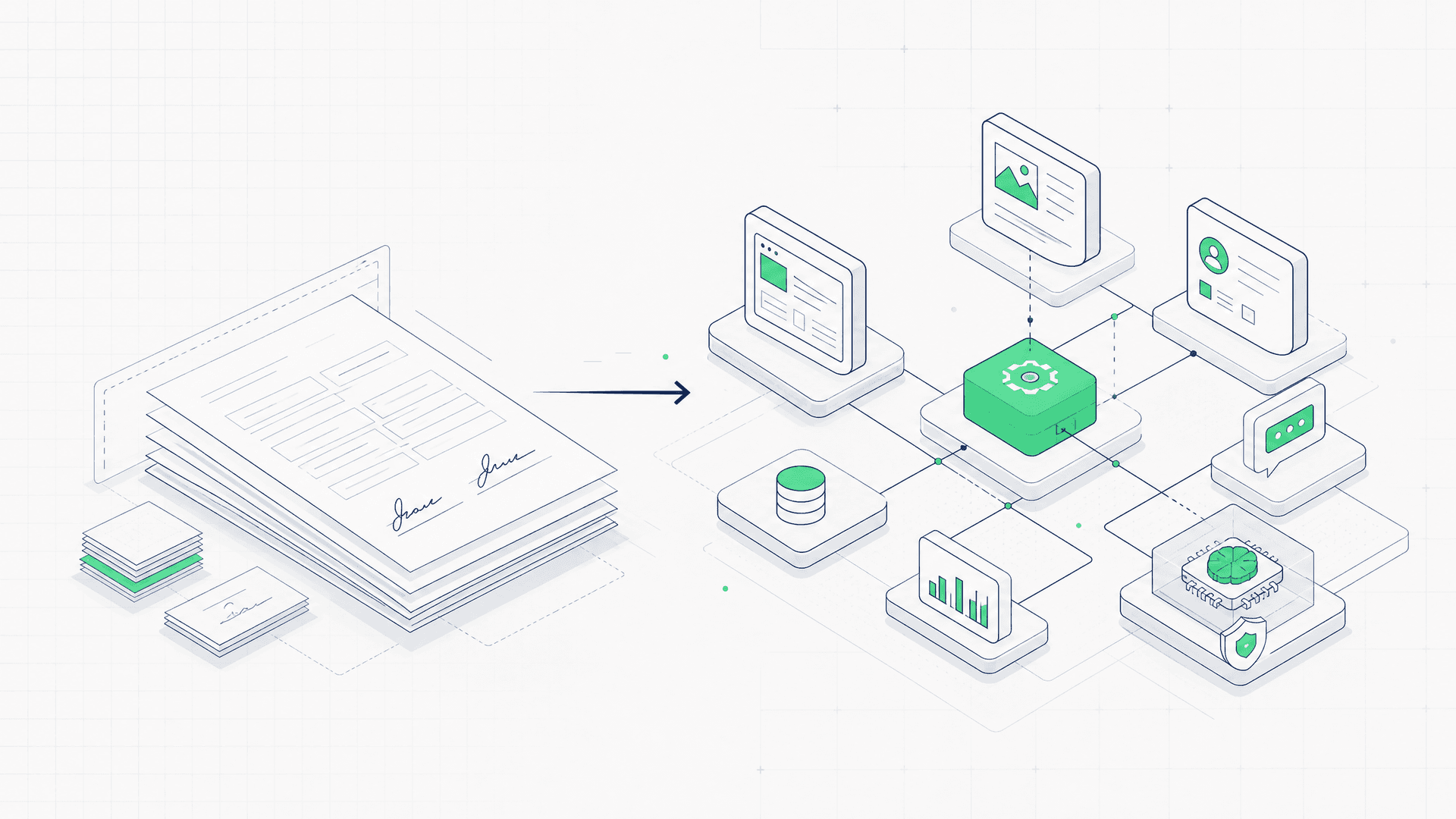
Autto first needed a better way to onboard dealerships. That engagement became the foundation for a separate, broader platform: a custom website, CMS, CRM, node-based automation builder, messaging system, first-party analytics, and compliance-constrained AI assistant.
At a glance: Autto is a third-party administrator in the automotive vehicle service contract space. We delivered two distinct systems: a dealer onboarding application for automotive F&I operations, followed by a custom go-to-market platform for the company’s public web presence and internal marketing operations.
| Project | Purpose | Delivery |
|---|---|---|
| Dealer onboarding platform | Replace a paper-heavy dealership onboarding and e-signature process | Built in three weeks |
| Go-to-market platform | Replace disconnected website, CMS, CRM, marketing, messaging, analytics, and AI tools | Built and launched by one engineer in approximately three months |
The client
Autto is a third-party administrator (TPA) in the vehicle service contract space. It serves three distinct audiences: dealers who sell coverage, agents who develop dealer relationships, and drivers who file claims. Each audience needs a different path through the business, while the underlying operation must remain accurate, responsive, and compliant.
The work began with a focused operational problem. It later expanded into a separate go-to-market platform that gives Autto control over how it publishes, captures leads, follows up, communicates, measures performance, and uses AI.
Part One: A Digital Dealer Onboarding Platform for Automotive F&I
The problem
Dealer onboarding in automotive F&I was a paper-heavy, error-prone process. When a new dealership joined an agency, representatives had to collect business information, configure product selections across multiple carriers, set override compensation structures for as many as 12 product lines per recipient, and route legally binding documents for signature—often to several people in different locations.
The starting process relied on multi-page PDF forms completed by hand. That created typos, missed fields, inconsistent formatting, and no dependable visibility into signature status. One override form contained more than 144 fields in a dense grid, which made precise placement difficult and left too much room for manual error. Field agents also had no mobile-friendly process, and management had no centralized view of the onboarding pipeline.
What we built
We built a dedicated, multi-section dealer onboarding application that guides a representative from dealership details through carrier selection, product configuration, override distribution, and signing in one session on any device.
Two capabilities made the application viable at scale.
Visual PDF field placement
The override form required more than 144 signing fields to be accurately placed in a dense layout. We built a custom visual PDF editor with multi-level zoom and coordinate normalization, allowing the field map to be defined accurately once and reused wherever that form was needed.
One template, two signing paths
The same document template supports two different signing experiences. For in-store use, representatives can launch an embedded signing ceremony without requiring an email. For remote use, the system sends the document for signature and tracks status through event callbacks. Both paths use the same field-placement definition, avoiding parallel form configurations and unnecessary maintenance.
What it changed
A multi-day paper process became a single-session digital workflow. Representatives gained a mobile-ready process, management gained real-time pipeline visibility, and numerous separate signing flows were consolidated into one conditional system with automated resends.
The onboarding platform was built in three weeks. More importantly, it proved the value of building around Autto’s actual operating model rather than forcing the business to work around disconnected tools.
Part Two: A Custom Website, CMS, CRM, and Automation Platform
The problem
Autto’s public website ran on a separate content platform, while lead capture, texting, spreadsheets, follow-up, and attribution were spread across disconnected tools. A website lead had no reliable route into a follow-up process, no dependable attribution, and no clear owner. Publishing a landing page could mean waiting for a developer.
At the same time, Autto operates in a regulated category. Any automation or AI system had to be designed around clear limits: it must not quote prices, promise coverage, or determine claim outcomes. The requirement was not simply to build a new marketing site. It was to create a system Autto could own and operate, where its website, CRM, marketing tools, communications, analytics, and AI work together with compliance embedded in the product.
What we built
A custom website built around audience intent
Autto’s public site is a fast, statically rendered web experience built to recognize the needs of different visitors. Drivers are directed toward claims, dealers toward partnership, and agents toward recruitment. A dedicated agent-recruitment microsite runs from the same application while maintaining its own visual identity and funnel.
This gives Autto tailored audience journeys without having to maintain separate systems for every part of the business.
A CMS that supports real marketing operations
The CMS allows the marketing team to publish pages in Markdown or HTML and embed working lead-capture funnels directly into those pages. Forms connect to the CRM, retain campaign attribution, and can enforce event capacity where needed.
An AI-assisted page writer can draft landing pages from a structured brief while applying Autto’s compliance rules. Automated checks verify that generated links and forms point to real destinations, reducing the chance of publishing a dead end.
For pages that require custom code, an in-admin code studio supports a controlled workflow: create a change, build a preview, review the result, and publish only when the build succeeds. Marketing can create and update landing pages with functioning funnels without submitting a development ticket for routine work.
A CRM shaped around Autto’s workflow
The CRM manages leads, dealerships, and contacts through flexible grid, kanban, calendar, gallery, and saved views. The team can define custom fields in the interface, take bulk actions, review activity timelines, and tailor working views to each audience.
It also accounts for the details that create operational friction. Duplicate form submissions are merged into one lead with a clear merge note instead of triggering multiple welcome messages. Suspicious submissions can be placed in a review queue rather than silently discarded.
A custom node-based automation builder
Autto needed automation that could reflect its own processes rather than the constraints of a prebuilt workflow product. We built a visual, node-based automation builder with triggers, conditional branches, delays, quiet hours, and custom action nodes.
Workflows can respond to events such as a new lead, a status change, a flagged conversation, or an RSVP. Actions can send personalized email and SMS, notify a team channel with a direct CRM link, assign an owner, update a record, or score a lead with AI. Every automation can be dry-run with real record data before it is activated.
Two-way communications and campaign delivery
The platform includes a two-way SMS inbox on a registered business line, template responses, and an optional AI responder operating behind non-overridable compliance rules. If the AI cannot help within those rules, it stays silent and alerts a human rather than improvising.
Email campaigns are managed in the platform as well. Teams can import lists, maintain a global suppression list, offer one-click unsubscribe, control sending pace, and review delivered, open, and click activity at the campaign level.
A compliance-constrained AI assistant
The public AI assistant uses retrieval-augmented generation to answer from Autto’s approved knowledge base rather than the open internet. It can help visitors navigate approved information, but it cannot quote prices, promise coverage, or make coverage or claim decisions.
When a visitor needs a person, the escalation is operational rather than theoretical. The conversation is flagged, the appropriate team is notified, and the full transcript reaches the right inbox automatically.
First-party analytics and privacy controls
Autto’s analytics system measures acquisition channels, campaign performance, visitor journeys, conversion funnels, and real-time activity without relying on third-party analytics software. It is cookieless by default, honors Global Privacy Control, connects consent to a meaningful banner, and links deletion requests directly to the CRM.
The result is a first-party measurement system that supports marketing decisions while keeping customer data under Autto’s control.
Technology foundation
The platform is built on a modern web application architecture with Postgres and pgvector for operational and retrieval data, alongside managed file storage, transactional email, business SMS, e-signature APIs, and retrieval-augmented AI workflows.
The point was never to assemble a stack for its own sake. It was to give Autto a durable, maintainable system that matches the way the business acquires, supports, and follows up with customers and partners.
Results
| Area | Result |
|---|---|
| Dealer onboarding | A multi-day paper process became a single-session digital workflow with real-time pipeline visibility |
| Signing workflows | Numerous separate signing flows became one conditional system with automated resends |
| Marketing operations | The marketing team can publish landing pages with working lead funnels and run email and SMS campaigns without routine developer dependence |
| Lead follow-up | Web inquiries and AI conversations have a defined, automated human follow-up path |
| Compliance | AI is restricted from quoting prices and making coverage or claim determinations by design |
| Data ownership | Website, CMS, CRM, automation, messaging, analytics, and AI operate as a connected first-party system |
What this project demonstrates
This was not a website redesign and it was not only a dealer onboarding tool. It was two distinct builds with a shared objective: give Autto better control over the operational workflows that matter most.
The dealer onboarding platform removed friction from a complex automotive F&I process. The broader go-to-market platform then gave Autto a custom site, publishing system, CRM, node-based automation builder, communications layer, analytics foundation, and AI assistant that can operate within the business’s compliance boundaries.
For automotive, F&I, insurance, and other regulated teams, the lesson is straightforward: the customer journey, internal workflows, marketing operations, and compliance controls can be designed as one connected system—without treating off-the-shelf tools as the operating model.
Discuss a similar platform build
If your team is replacing fragmented workflows with a connected platform, we can help define the operational, technical, and compliance requirements before building.