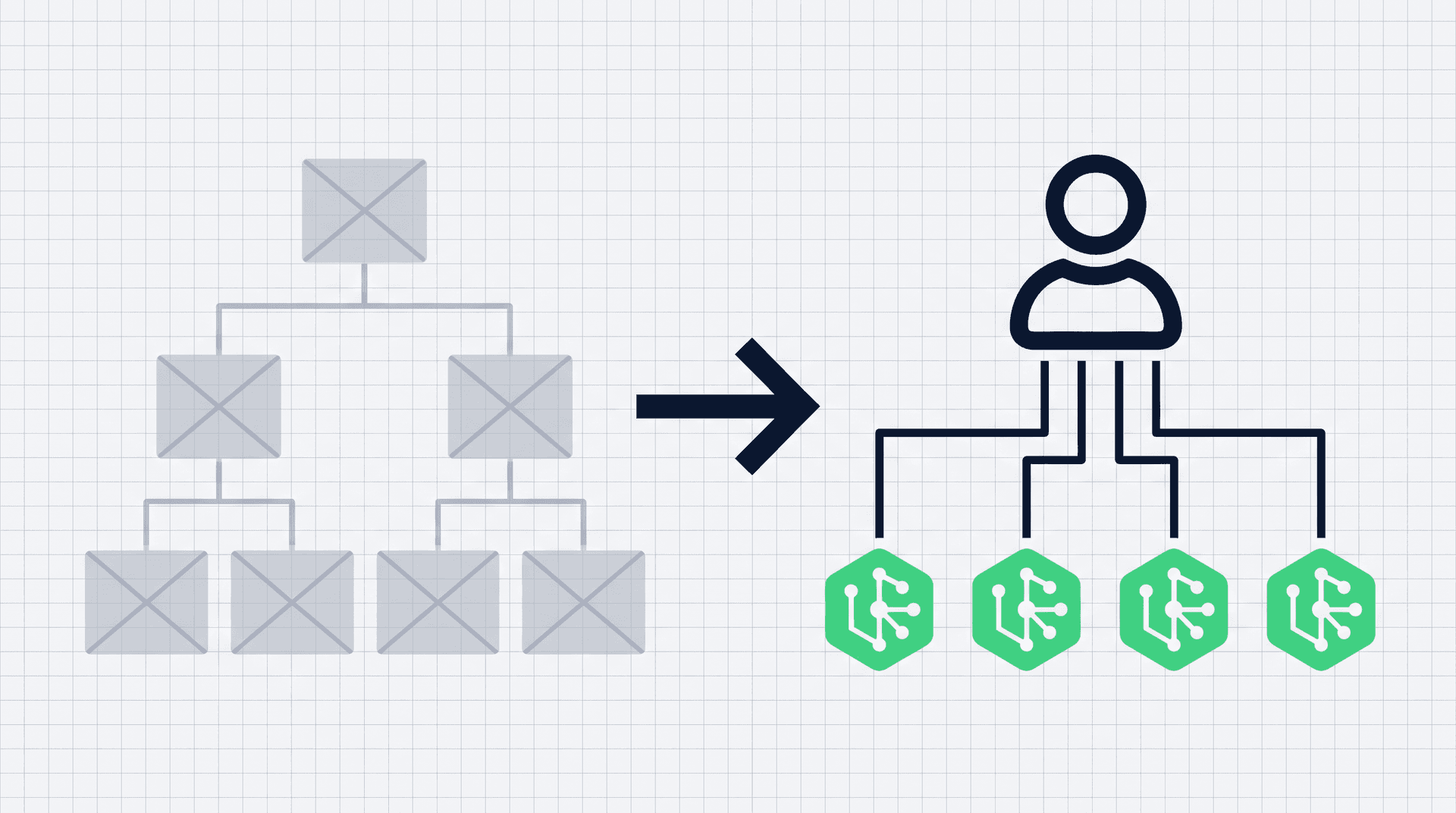
The traditional agency model is under real pressure. As AI capabilities expand and businesses demand more for less, the comfortable retainer-based agency structure is coming apart faster than most realize.
Here's an uncomfortable truth: if your creative agency is still billing hours for tasks that AI can complete in seconds, that work is already on the way out. You just may not know it yet.
A meaningful share of traditional agency roles, the routine production work, can already be automated today. That isn't a distant future scenario. And if you're reading this thinking "but AI can't replace human creativity," you're missing the point entirely.
- Roles: Routine production work most at risk
- Cost: Lower with AI tools than agency retainers
- Output: More per strategist with the right system
The Commoditization of Execution
The Race to Zero
Let's examine what AI can do today, in April 2026, compared to just two years ago:
| Task | 2024 Agency Time | 2026 AI Time | Quality Difference |
|---|---|---|---|
| Blog post (1,000 words) | 4 to 6 hours | 3 to 5 minutes | Negligible |
| Social media campaign (30 posts) | 2 to 3 days | 15 minutes | Often better |
| Landing page design + copy | 1 week | 1 hour | Comparable |
| Email drip sequence (10 emails) | 2 days | 20 minutes | More personalized |
| Brand identity package | 2 to 3 weeks | 2 to 3 hours | Requires curation |
This isn't about AI being "good enough." Modern language models consistently hold their own against junior copywriters in blind tests. Image generation models produce commercial-quality visuals that hold up against stock photography. And they do it instantly, at volume, without coffee breaks.
The uncomfortable reality? Most agency work isn't high-level strategy. It's execution. Writing the 47th variation of a product description. Resizing banner ads. Scheduling social posts. Tasks that feel creative but follow predictable patterns. Patterns that AI has mastered.
The Shift to Strategy and Curation
From Creation to Orchestration
The future of creative work isn't in manual production. It's in three critical areas where humans still dominate:
System Architecture
Designing the workflows, prompts, and guardrails that enable AI to produce consistent, on-brand content at scale.
Quality Curation
Selecting, refining, and combining AI outputs to create something greater than the sum of automated parts.
Strategic Direction
Understanding business context, market dynamics, and human psychology in ways AI cannot replicate.
Picture how a modern creative shop adapts its model. Instead of rooms full of copywriters crafting headlines, the team orchestrates creative systems. One person can manage AI generation of thousands of ad variations, test them in real time, and optimize based on performance data.
The skill isn't in writing the copy. It's in knowing which copy will resonate with which audience at which moment. It's in building the system that generates, tests, and deploys creative at a scale no human team could match.
Real Examples: How Businesses Are Already Replacing Agencies
From Our Portfolio
Autto.com: Replacing a Content Team with AI Workflows
When Autto.com needed to scale their dealer communications from dozens to thousands, they faced a choice: hire an agency or build an AI system. They chose to build.
- Previous approach: Manual email creation, days per campaign
- AI system result: Automated generation, minutes per campaign
- Cost: A fraction of the agency quotes
The system we built generates dealer-specific onboarding sequences, follow-up campaigns, and compliance notifications, all maintaining brand voice while personalizing for each dealer's context.
Data Intelligent Nexus: From Agency Reports to Automated Intelligence
An automotive group was paying a hefty monthly retainer for marketing analytics reports that arrived two weeks late. We replaced their agency with an AI-powered data nexus.
- Report generation: From two weeks to real time
- Insights depth: Far more granular with AI analysis
- Monthly savings: Most of the old retainer, after system costs
The AI system automatically ingests data from all marketing channels, generates performance insights, and creates custom reports for each stakeholder, something their agency couldn't scale to provide.
- Strategy Session: Define goals & workflows
- Build System: Custom AI infrastructure
- Scale Output: Higher content volume
Building Internal Capabilities
The In-House Revolution
Smart businesses aren't waiting for agencies to adapt. They're building their own AI infrastructure. Here's why this makes economic sense:
| Investment Type | Traditional Agency | Internal AI System |
|---|---|---|
| Monthly Cost | Five-figure retainer | Tools plus oversight, far less |
| Speed to Market | Weeks per campaign | Days per campaign |
| Content Volume | Limited by billable hours | Virtually unlimited |
| Brand Consistency | Varies by team member | Programmatically enforced |
| Knowledge Retention | Lost when team changes | Embedded in system |
Consider what a large commerce platform can do. Instead of hiring agencies for merchant marketing support, it builds an in-house AI system that generates product descriptions, email campaigns, and ad copy tailored to each merchant's brand. One system can serve a huge base of merchants with personalized creative that would have required thousands of agency hours.
Or look at how a global marketplace can transform its localization strategy. Rather than contracting translation agencies, it builds an AI pipeline that adapts listings across many languages while maintaining each host's unique voice. The system processes far more content in a day than agency partners handled over much longer stretches.
The Build vs. Buy Decision
For businesses considering this shift, here's the framework:
Build Internal AI When:
- ✓ You have predictable content needs
- ✓ Brand consistency is critical
- ✓ Speed to market matters
- ✓ You need 24/7 availability
- ✓ Content volume is high
Keep Agency Partners When:
- ✓ You need strategic thinking
- ✓ Creative direction is complex
- ✓ Market insights are valuable
- ✓ Campaign strategy is evolving
- ✓ Human creativity adds value
The Agency Pivot Playbook
From Extinction to Evolution
Agencies that survive won't be the ones that resist AI. They'll be the ones that embrace a fundamental shift in their value proposition. Here's the transformation roadmap:
1. Stop Selling Time, Start Selling Systems
The billable hour is dead. Clients don't want to pay for your junior designer to learn on their dime. They want outcomes. Package your expertise into AI-powered systems that deliver consistent results.
2. Become AI Implementation Partners
Instead of doing the work, teach clients how to build their own creative engines. Design their prompt libraries. Set up their workflows. Train their teams. Be the architect, not the builder.
3. Focus on What AI Can't Do (Yet)
Strategic thinking. Cultural insight. Emotional intelligence. Complex problem-solving. These remain human domains. Double down on high-level strategy while AI handles execution.
4. Build Proprietary AI Tools
Don't just use an off-the-shelf chatbot. Build custom models trained on your unique methodologies. Create tools that embody your agency's expertise. License them to clients as SaaS products.
The Clock Is Ticking
By 2027, agencies still billing hourly for AI-replaceable tasks will struggle to exist. The question isn't whether to adapt, but how quickly you can transform your business model.
At Grid Theory, we're helping forward-thinking agencies build their AI transformation strategy. From custom automation systems to AI-powered creative tools, we're architecting the infrastructure that turns agencies into AI powerhouses.
Discuss Your Agency's AI Strategy
Conclusion: Evolution or Extinction
The reckoning is coming for most creative agencies. The clock is ticking: adopt AI or fade out.