Your Website Isn't Slow — It's Bleeding Revenue

Your Website Isn't Slow — It's Bleeding Revenue
Every extra second your website takes to load costs you customers, conversions, and cash. Here's the brutal math behind why website speed isn't a nice-to-have — it's a business survival metric.
The Revenue Hemorrhage: What Slow Speed Actually Costs
Most business owners think a "slow" website is just annoying. The reality? It's a silent profit killer that's bleeding your revenue every single day.
of users abandon sites taking 3+ seconds to load
conversion drop for every 100ms delay
lost annually by Amazon for every 100ms delay
Let's translate this into your business reality: If your website gets 10,000 monthly visitors with a 2% conversion rate and $50 average order value, a 2-second delay costs you $7,000 in monthly revenue. That's $84,000 per year — gone.
The Hidden Performance Tax on Your Business
Website speed doesn't just affect sales — it cascades through every part of your business:
- SEO Rankings: Google penalizes slow sites. Lower rankings = less organic traffic = fewer customers finding you
- Ad Spend Efficiency: Slow landing pages crater your Quality Score, driving up cost-per-click by 30-50%
- Customer Lifetime Value: First impressions matter. Slow sites create negative brand associations that persist
- Mobile Revenue: 53% of mobile users abandon sites taking 3+ seconds. That's half your mobile market walking away
- Competitive Advantage: Your faster competitors are literally stealing your customers while your site loads
The Speed-to-Revenue Correlation
Here's the data that should terrify every business owner:
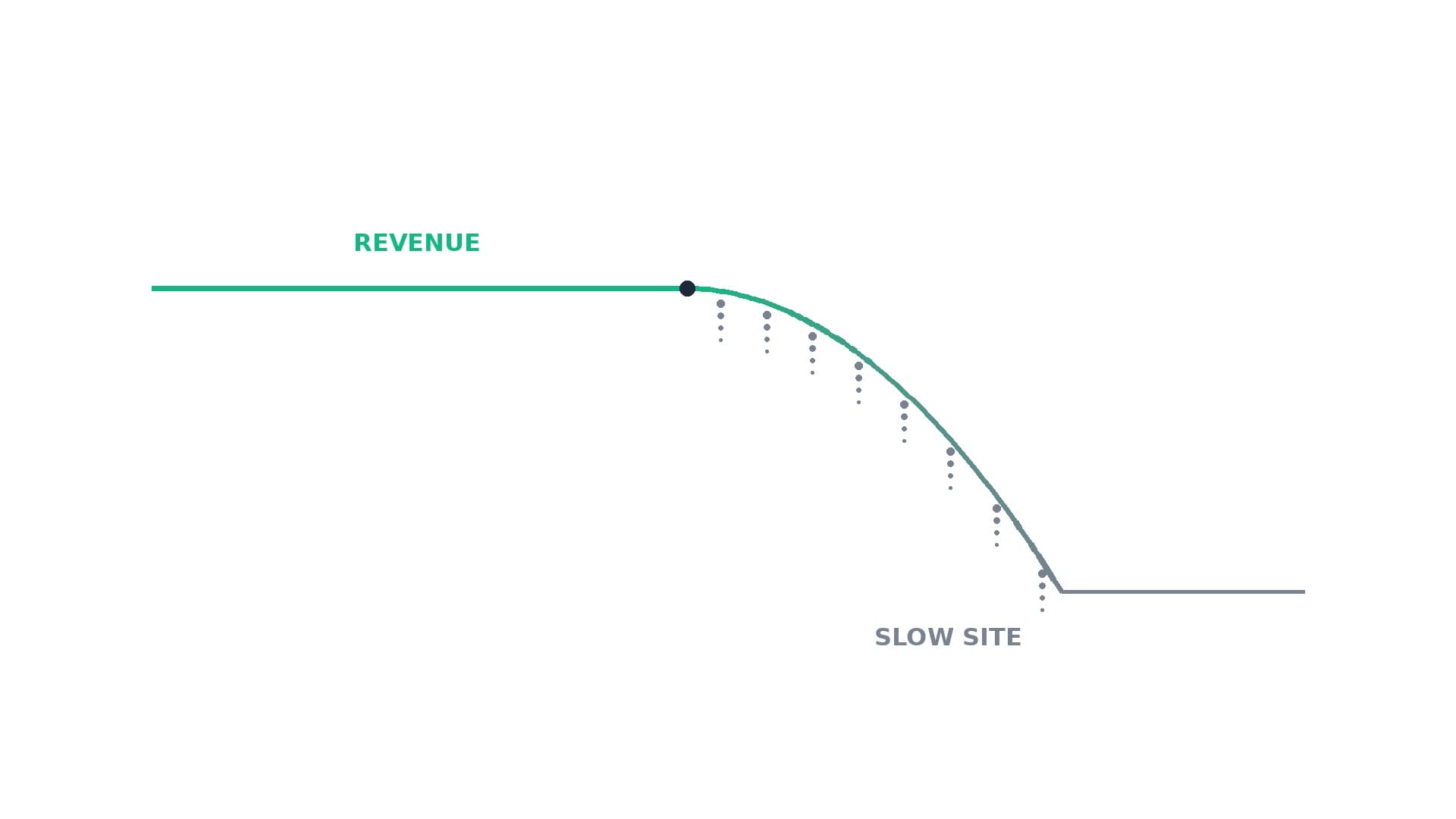
Website load time vs. conversion rate — the cliff is steeper than you think
This isn't theory. This is measured data from millions of real user sessions. Notice how the conversion rate doesn't decline gradually — it falls off a cliff after 3 seconds.
What's Actually Slowing You Down
Most "website optimization" advice focuses on surface-level fixes. The real performance killers are deeper in your infrastructure:
Database Performance Issues
- Unoptimized queries that scan entire tables instead of using indexes
- N+1 query problems that make 100 database calls instead of 1
- Missing caching layers that force redundant data fetches
Frontend Bloat
- JavaScript bundles that load dozens of unused libraries
- Images served at full resolution regardless of device
- CSS frameworks that include 90% unused styles
Infrastructure Bottlenecks
- Single server architectures that can't handle traffic spikes
- Geographic latency from hosting in one location
- No CDN or improperly configured edge caching
The Cost of Inaction: A Real Business Scenario
Let's run the numbers on a typical service business:
Before Optimization:
- Website load time: 4.2 seconds
- Monthly traffic: 15,000 visitors
- Current conversion rate: 1.8%
- Average customer value: $2,500
- Monthly revenue: $67,500
After Speed Optimization:
- Website load time: 1.1 seconds
- Monthly traffic: 15,000 visitors (same)
- Improved conversion rate: 3.2%
- Average customer value: $2,500 (same)
- Monthly revenue: $120,000
Revenue increase: $52,500/month = $630,000/year
This isn't optimistic projecting — this is conservative math based on documented conversion improvements from speed optimization.
Why Generic "Speed Tips" Don't Work
Every business owner has read articles about compressing images and minifying CSS. Here's why generic advice fails:
- Wrong Diagnosis: Most sites have unique bottlenecks that generic tips don't address
- Surface-Level Fixes: Optimizing images won't help if your database queries are taking 2 seconds
- No Performance Monitoring: You can't optimize what you don't measure consistently
- Technical Debt: Years of "quick fixes" create architectural problems that need systematic solutions
Real performance optimization requires custom analysis of your specific infrastructure, user patterns, and business logic.
The Strategic Approach to Performance
At Grid Theory, we don't just make websites faster — we architect performance into every layer of your digital infrastructure:
1. Performance Audit & Bottleneck Analysis
We instrument your entire stack to identify the real performance killers, not just the obvious ones.
2. Database Optimization
Query optimization, intelligent caching, and database architecture that scales with your business.
3. Frontend Performance Engineering
Code splitting, lazy loading, and progressive enhancement that delivers content when users need it.
4. Infrastructure Scaling
CDN configuration, edge computing, and server architecture designed for your traffic patterns.
5. Ongoing Performance Monitoring
Real-time alerts and automated optimization that keeps your site fast as it grows.
Stop Losing Revenue to Slow Load Times
Every day you wait is money left on the table. Let's audit your site's performance and show you exactly how much speed is costing your business.
Get Your Performance AuditFree 30-minute analysis — We'll show you the specific bottlenecks killing your conversions
Grid Theory
Building AI-powered infrastructure for businesses ready to scale.
Related Articles
Why Your CRM Isn't a Growth Strategy — It's Just a Database
Most businesses spend thousands on CRM software, then wonder why their sales aren't growing.
The Startup Launch Checklist:
The Startup Launch Checklist: Digital Infrastructure You Need Before Day One
Why Custom AI Beats Off-the-Shelf Every Time
Off-the-shelf AI tools are built for everyone, which means they're optimized for no one. Here's why custom builds win.