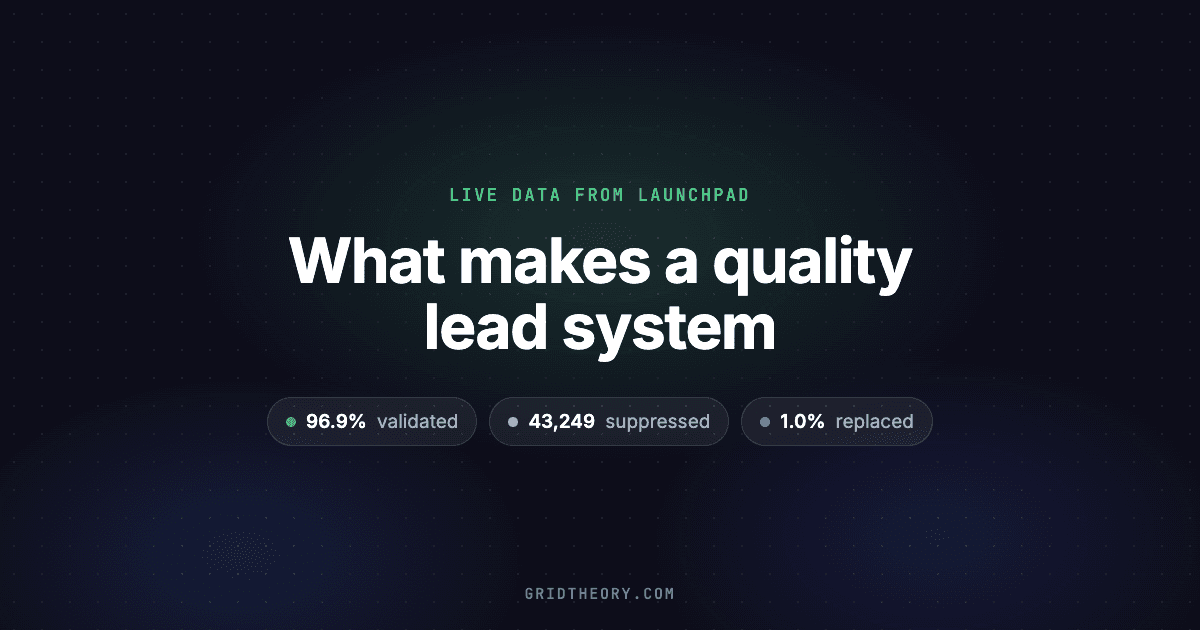
An insurance lead system is the software that takes leads in, checks them, sells or assigns them to agents, and tracks what happens next. A quality one does five jobs before an agent ever dials: it checks every lead before anyone pays for it, keeps bad and repeat numbers out, gets each lead to an agent fairly, makes good on the leads that fail, and ties every sale back to the lead that produced it. Miss one and you pay twice: once for the lead, and again in wasted dials.
Whether you call it a lead system, a lead management system, or lead distribution software, the features below are what separate a good one from an expensive one. Every example comes from Launchpad, the lead platform we built at Grid Theory for life insurance agents. It has taken in more than 500,000 leads since June 2026, and every number here comes from its live database on October 6, 2026.
Key takeaways
- Validate every phone number before a lead can be sold, and pull the ones that fail before an agent sees them. On Launchpad, 96.9% of checked leads have passed.
- Keep one suppression list and check it everywhere a lead can change hands, so a sold or replaced number is never sold again.
- Fill orders automatically and in rotation, so no agent is favored and no agent gets the same lead twice.
- Put replacement rules in writing and check claims automatically. On Launchpad, 1.0% of deliveries have been replaced.
- Judge leads by cost per sale, not cost per lead. That takes a lead system and a CRM that share the same records.
Leads that passed validation
96.9%
398,604 of 411,328 checked
Numbers on the suppression list
43,249
Never sold again
Deliveries replaced
1.0%
3,872 of 379,462 leads
Launchpad's live numbers, October 6, 2026.
1. Validation before a lead can be sold
What it is: every phone number gets a live check before the lead can be sold, and a lead that fails is pulled before any agent sees it.
Why it matters: a disconnected number is the most common complaint about bought leads, and the cheapest one to prevent. Checking at the door costs less than refunding later.
How Launchpad does it: every number is checked with a phone validation service that scores how likely it is to connect. A lead can't be sold until it passes, and that rule lives in two places: the store only counts validated leads as available, and the code that fills orders refuses anything that hasn't passed. A passing result is reused for 30 days, so the same number isn't paid for twice.
398,604 of 411,328. 12,724 failed and were pulled before any agent saw them
2. Intake checks and deduplication
What it is: rules that stop bad data at the door: impossible ages, states you don't sell in, and people you already have.
Why it matters: duplicates quietly wreck lead quality. The same person bought twice means an annoyed prospect and a wasted purchase.
How Launchpad does it: every lead is checked as it arrives. Ages outside 18 to 84 and states Launchpad doesn't sell in are held back automatically. Uploaded lists are compared against existing inventory by phone number and email, so a re-uploaded list can't put the same people back on the shelf, and the same file can't be imported twice within ten minutes.
Leads held back or pulled at intake, by reason
View as table
| Reason | Leads |
|---|---|
| Duplicate re-uploads | 77,015 |
| Over the age limit | 18,147 |
| Invalid or excluded state | 3,961 |
| Missing or invalid age | 1,859 |
3. A suppression list checked everywhere
What it is: a list of numbers that must never be sold again, such as previously sold numbers and leads that were replaced, checked anywhere a lead could change hands.
Why it matters: selling the same person twice is how a lead business loses trust fast. The list only works if every part of the system checks it.
How Launchpad does it: the suppression list holds 43,249 numbers, and the store's counts, checkout, every order fill, and the daily aging job all check it. Replaced leads are added automatically. Numbers are stored as one-way hashes, not as raw phone numbers or emails.
4. Fair, automatic distribution
What it is: orders fill themselves in rotation, and no one hand-picks who gets which lead.
Why it matters: manual assignment is slow and invites favoritism. Agents who buy the same product should get the same treatment.
How Launchpad does it: a fulfillment job runs every minute. Each pass gives every open order at most one lead, starting with the order served least recently, so a big order can't crowd out a small one. Database locks make sure two orders can never grab the same lead at the same moment, and no agent can receive the same lead twice. Real-time buyers choose at least 25 target states, and each lead is drawn from those states in proportion to the stock available. Paid orders are filled only by this job, never by hand.
5. Clear tiers, and a resale rule you can explain
What it is: separate products for brand-new leads and older ones, with a stated rule for when a lead can be sold again.
Why it matters: a lead from five minutes ago and a lead from six months ago are different products. Blurring the two is how buyers end up overpaying.
How Launchpad does it: every lead carries an age tier, from real-time to 181+ days, and a daily job moves leads into older tiers as they age. A real-time lead is sold to one agent. Once a lead ages into an older tier, it can be offered again to a different agent, but never to the same agent twice, and never if it became a sale, was replaced, or landed on the suppression list.
6. Replacements with rules, checked automatically
What it is: a built-in way for agents to flag a bad lead and get a new one, with clear rules about what qualifies.
Why it matters: even a validated number can go dead. A fast, fair replacement process is what keeps agents buying.
How Launchpad does it: agents can request a replacement within 72 hours of delivery (24 hours for aged leads), for up to 15% of an order. A "disconnected number" claim triggers a fresh live check of the number before anyone reviews it. Over-age claims, and claims that a lead is from a state the agent isn't licensed in, are approved automatically when the data backs them up. The replacement ships first, then the bad lead is retired and added to the suppression list.
So far, 1.4% of delivered leads have had a replacement requested, and 1.0% were approved.
5,159 requests on 379,462 delivered leads
View as table
| Reason | Requests |
|---|---|
| Disconnected number | 4,185 |
| Other | 714 |
| Wrong state | 159 |
| Over the age limit | 101 |
7. Texting safeguards built in
What it is: rules inside the texting tools that protect agents from the most common texting mistakes.
Why it matters: an automated text to someone who said stop, or one that lands at 10 p.m., is the kind of mistake that turns into a complaint, or worse. The federal rules got stricter in 2025. Under the FCC's consent revocation order (FCC 24-24), in effect since April 11, 2025, people can revoke consent to automated calls and texts in any reasonable way. Replies like "stop," "quit," "cancel," or "unsubscribe" count automatically, and an opt-out must be honored within 10 business days (47 CFR 64.1200(a)(10)).
How Launchpad does it: a STOP reply, or a plain-English one like "stop texting me," shuts off texting to that person automatically. A lead who declined texts isn't texted unless they write first. Automated follow-up texts only go out between 9 a.m. and 8 p.m. in the lead's own time zone. Landlines are skipped, numbers that stop accepting texts drop out of automation, and every message goes through a registered business texting service (A2P 10DLC). This isn't legal advice: have your compliance team or attorney review how your agents call and text.
8. Tracking from lead to policy
What it is: the lead system and the CRM are the same place, so every call, appointment, and sale is logged against the lead that produced it.
Why it matters: you can't judge leads you can't trace to revenue. Cost per sale, not cost per lead, is the number that matters.
How Launchpad does it: agents log each lead's status as they work it, and a sale can't be logged without the carrier and the premium. Each order then shows how many leads were delivered, how many sold, the annual premium written, the cost per sale (spend divided by policies sold), and the return on what was spent. That's how Launchpad can report that its agents have written more than $4.7 million in annual premium from its leads in four months.
9. Monitoring that catches problems first
What it is: automated checks that watch the system itself and alert a person before agents notice a problem.
Why it matters: a stuck order or a stalled validation service costs money every minute nobody notices.
How Launchpad does it: every 10 minutes, a health check looks for paid orders that haven't filled, leads sold more times than allowed, deliveries outside an order's states, server errors, payments missing their confirmation, and a stalled validation queue. When a check fails, the team gets an email. A daily report sums up leads in, leads held back by reason, and leads sold.
A quick checklist
Before you buy leads from a vendor, or build your own system, ask:
- Is every number validated before it can be sold, and what happens to the ones that fail?
- How are duplicates caught when lists are uploaded?
- Is there a suppression list, and is it checked everywhere a lead can be sold?
- Who decides which agent gets which lead, and can one agent get the same lead twice?
- Are real-time and aged leads separate products, and when can a lead be sold again?
- What qualifies for a replacement, how long do agents have to ask, and how is a claim checked?
- Does texting honor opt-outs and quiet hours automatically?
- Can you see cost per sale for every order?
- Who watches the system, and who gets told when something breaks?
And one more: who owns the system and the data?
Frequently asked questions
What is an insurance lead system? It's the software that takes leads in, checks them, sells or assigns them to agents, and tracks what happens next. In Launchpad, that is one platform: intake, validation, a lead store, distribution, a CRM, and reporting.
What is lead validation? Lead validation means checking a lead's contact details, usually the phone number, before the lead is sold or worked. On Launchpad, every number gets a live check that scores how likely it is to connect, a lead that fails is pulled before any agent sees it, and a passing result is reused for 30 days.
What is a suppression list? A suppression list is a list of numbers that must never be sold again, such as numbers already sold and leads that were replaced. It only works if every part of the system checks it. Launchpad's holds 43,249 entries, stored as one-way hashes rather than raw phone numbers or emails.
What is a good lead validation rate? It depends on where the leads come from. Launchpad's sources pass about 97% of the time (398,604 of 411,328 checked as of October 6, 2026). What matters more than the rate is that failed leads are never sold.
How often should leads need to be replaced? On Launchpad, 1.4% of delivered leads have had a replacement requested and 1.0% were approved, mostly for disconnected numbers. A rising rate is an early warning that a lead source is slipping.
What's the difference between real-time and aged leads? Real-time leads are brand new; aged leads are older and cost less. Launchpad labels every lead by age and moves it into older tiers as it ages, and an aged lead can be sold again to a different agent but never to the same agent twice.
Should I build my own lead system or rent one? Renting is fine to start. Owning makes sense when leads become a revenue line, when you need rules your software can't express, or when you want your data in your own hands. Launchpad replaced rented software and spreadsheets with one platform its owner controls.
Who built Launchpad
Grid Theory designs and builds private, high-control software that a business owns outright: lead platforms, CRMs, follow-up automation, and private AI, built into how the business already runs. Launchpad is one of those systems. See what we build, how we work with insurance agencies, or what Launchpad did in its first four months.
If you want a lead system built around how your agency actually sells, book a call.