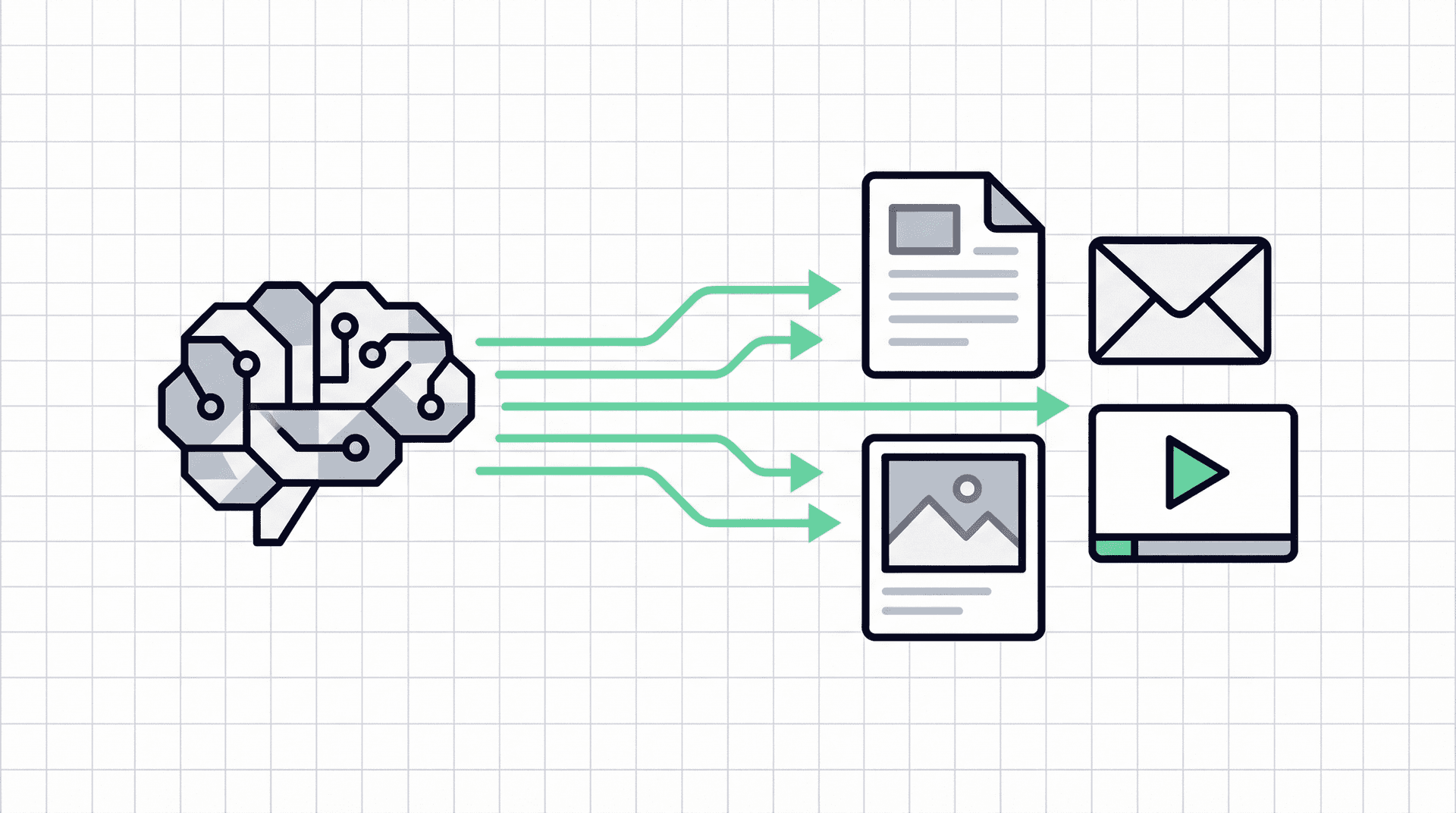
Content still drives growth, but the demands for creating and distributing it have never been higher. Business owners are constantly looking for better ways to engage their audience, drive traffic, and convert leads, all while working with limited resources and tight budgets. The sheer volume of content required to stay competitive can be overwhelming, leading to burnout and missed opportunities. This article explains how artificial intelligence (AI) can reshape your content strategy, helping you generate high-quality, relevant content and distribute it effectively at scale, so content creation stops being a bottleneck for your business.
The Content Conundrum: Why AI is Your Strategic Advantage
For many businesses, the traditional approach to content creation is a bottleneck. Manual research, writing, editing, and distribution are time-consuming and often fail to keep pace with market demands. This is where AI earns its place. AI-powered tools can automate repetitive tasks, analyze large datasets for content ideas, personalize content for specific audiences, and assist in the writing process itself. With AI, businesses can:
- Increase content velocity: Produce more content in less time, ensuring a consistent flow of fresh material.
- Enhance content quality: AI can help refine language, check for grammar and style, and suggest improvements based on performance data.
- Improve personalization: Deliver highly relevant content to individual users, boosting engagement and conversion rates.
- Optimize distribution: Identify the best channels and times to publish content for maximum reach and impact.
- Reduce costs: Automate tasks that would otherwise require significant human effort, freeing up resources for strategic initiatives.
Leveraging AI Across the Content Lifecycle
Putting AI to work in your content strategy means applying it at various stages, from ideation to performance analysis.
1. Content Ideation and Research
AI tools can analyze trending topics, search queries, competitor content, and audience demographics to identify content gaps and high-potential keywords. This data-driven approach keeps your content relevant and focused on the needs of your target audience.
- Topic generation: AI can suggest blog post ideas, video scripts, and social media campaigns based on current trends and audience interests.
- Keyword research: AI algorithms can uncover long-tail keywords and semantic variations that human researchers might miss, optimizing your content for search engines.
- Audience insights: AI can segment your audience and provide insights into their preferences, pain points, and consumption habits, allowing for tightly targeted content creation.
2. Content Generation and Creation
While AI cannot fully replace human creativity, it can significantly assist in the content creation process, acting as a capable co-pilot.
- Drafting and outlining: AI writers can generate initial drafts, outlines, and summaries, providing a solid foundation for human writers to build upon.
- Copywriting: For product descriptions, ad copy, and social media posts, AI can generate multiple variations quickly, allowing for A/B testing and optimization.
- Repurposing content: Transform existing long-form content into shorter formats like social media snippets, email newsletters, or infographics with AI assistance.
- Multilingual content: AI translation tools can rapidly localize content for global audiences, expanding your reach without extensive manual effort.
3. Content Optimization
Once content is created, AI can help refine it for better performance and discoverability.
- SEO enhancement: AI tools can analyze your content for SEO best practices, suggesting improvements for readability, keyword density, and internal linking.
- Grammar and style checks: Beyond basic spell-checking, AI can identify complex grammatical errors, improve sentence structure, and keep a consistent brand voice.
- Personalization: Dynamic content generation lets AI tailor specific sections or recommendations within an article based on individual user behavior and preferences.
4. Content Distribution and Promotion
Getting your content in front of the right audience is crucial. AI can streamline and optimize your distribution efforts.
- Social media scheduling: AI can determine the optimal times to post on various social media platforms to maximize engagement.
- Email marketing automation: AI can segment email lists, personalize subject lines and content, and automate send times for higher open and click-through rates.
- Content syndication: AI can identify relevant platforms and publications for syndicating your content, expanding its reach organically.
- Ad campaign optimization: AI can manage and optimize your paid advertising campaigns, helping your content reach the most receptive audience segments.
5. Performance Analysis and Iteration
AI's analytical capabilities are valuable for understanding content performance and informing future strategies.
- Data analysis: AI can process large amounts of data from website analytics, social media, and CRM systems to provide actionable insights into content effectiveness.
- Predictive analytics: Forecast future content trends and audience behavior, so you can adjust your content strategy proactively.
- A/B testing: AI can automate and analyze A/B tests for headlines, calls-to-action, and content formats, identifying what resonates best with your audience.
The Grid Theory Angle: Building Custom AI Content Systems
Off-the-shelf AI tools offer a starting point, but real competitive advantage in AI-driven content generation and distribution comes from custom-built systems tailored to your business. This is where Grid Theory works best. Our approach is not about generic solutions. It is about understanding your specific content challenges, your target audience, and your business objectives, then engineering AI systems that fit cleanly into your existing workflows.
At Grid Theory, our way of working shapes how we design and implement these AI content solutions:
- Goal-oriented design: We begin by defining your content goals. Are you aiming for lead generation, brand awareness, customer retention, or a combination? Our AI systems are designed from the ground up to achieve these specific, measurable outcomes.
- Robust integration: Our solutions are built to integrate with your existing tech stack, whether that is your CRM, CMS, marketing automation platforms, or analytics tools. This keeps your content ecosystem unified and efficient.
- Intelligent automation: We implement automation that goes beyond simple task execution. Our AI learns and adapts, continuously refining content generation, personalization, and distribution based on real-time performance data.
- Data-driven optimization: Every part of our AI content systems is driven by data. We set clear metrics, track performance rigorously, and use those insights to iteratively improve your content strategy and your return on investment.
By partnering with Grid Theory, you're not just adopting AI. You're investing in a strategic asset that turns your content operations from a cost center into a growth engine. We move past the limits of generic tools and give you a scalable, efficient content system that consistently delivers results.
Ready to Get Started?
Building the right systems doesn't have to be overwhelming. Grid Theory helps businesses design and implement solutions that actually work, no bloated platforms, no guesswork.
Book a discovery call and let's talk about what this could look like for your business.