Introduction: Streamlining Your Client Journey in 2026
A new client decides how they feel about you in the first few weeks, long before you deliver anything substantial. And for most businesses, those weeks are a mess of manual work: chasing signatures, re-typing the same contact details into three systems, waiting on someone to remember the welcome email. Every delay chips away at the confidence that won you the deal in the first place. In 2026, clients compare your onboarding to the slickest software signup they used that morning, and the bar keeps rising. A smooth onboarding experience stopped being a luxury a while ago. This article walks through how to automate client onboarding from first contact to first invoice: why it matters, where to start, and how to turn a clumsy handoff into a professional, scalable operation.
The Imperative of Automating Client Onboarding
What is Client Onboarding Automation?
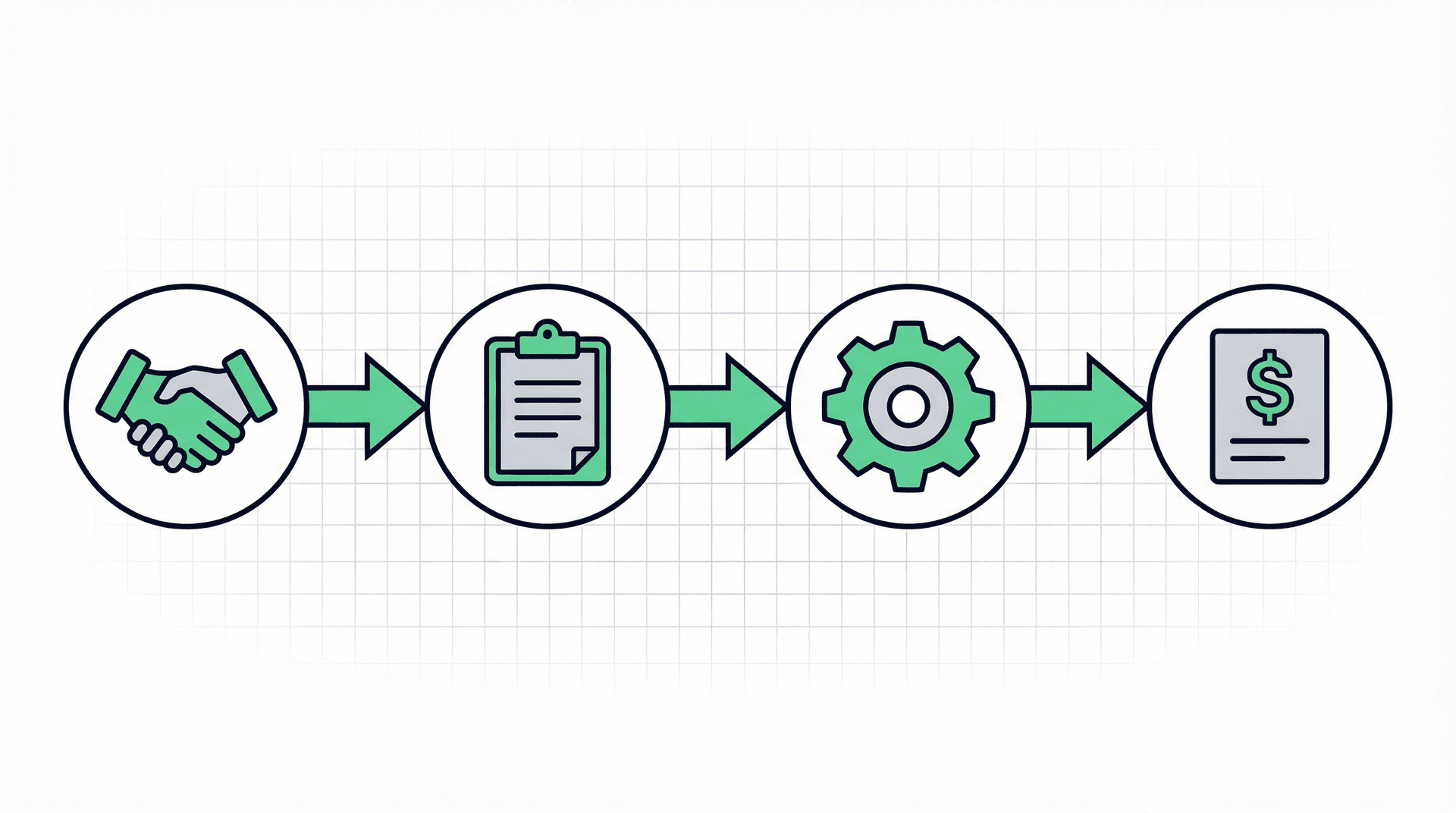
Client onboarding automation means using software to standardize the steps a new client moves through when they join your business: initial communication, contract signing, data collection, service setup, and the first billing cycle. The point is simple. Less manual intervention, fewer human errors, and a shorter path from "signed" to "getting value."
Why Automate Now? The 2026 Business Landscape
- Enhanced client experience. Clients expect fast, personal service from day one. Automated onboarding delivers consistent, timely communication and a clear path forward, so nobody is left wondering what happens next.
- Increased efficiency and productivity. Welcome emails, intake forms, account setup: none of that needs a human. Automate it and your team's time goes to the work that actually requires judgment, like strategy and direct client conversations.
- Reduced human error. Manual data entry breaks things. A name typed wrong in the CRM becomes a wrong name on the contract and a wrong name on the invoice. Automation keeps client information, contract details, and billing accurate the whole way through.
- Faster time-to-revenue. The sooner a client is fully onboarded, the sooner they're using your services and the sooner you can bill. That shows up directly in cash flow and growth.
- Scalability. Manual processes that feel fine at low volume become bottlenecks as you grow. Automated systems absorb more new clients without a matching increase in administrative overhead.
- Compliance and data security. Workflows can be built to collect and store every required legal and compliance document automatically, which takes a whole category of risk off your plate.
Key Stages of the Client Onboarding Process Ripe for Automation
- Initial contact and lead qualification: automatic first responses, qualification questionnaires, and discovery call scheduling.
- Proposal and contract management: customized proposals, e-signatures on contracts, and secure storage of legal documents.
- Information gathering: client data collected once, through online forms, surveys, and secure portals, instead of over a dozen emails.
- Service setup and provisioning: client accounts, access credentials, and service delivery kicked off by predefined workflows the moment the contract is signed.
- Welcome and orientation: welcome kits, introductory materials, and initial training sessions delivered without anyone touching a calendar.
- First invoice and payment setup: invoice generation, payment reminders, and a clean handoff into your accounting system.
Practical Steps to Implement Client Onboarding Automation
Rolling this out is a project, not a purchase. Here is the sequence that works:
- Map your current onboarding journey. Write down every step of the existing process: every touchpoint, document, and person involved. The gaps and the busywork become obvious once they're on paper.
- Define your ideal automated workflow. Design the process you actually want. Decide what information gets collected, what actions fire, and what communications go out at each stage.
- Choose the right tools. Pick automation software that talks to your existing CRM, project management tools, accounting software, and communication platforms. You want customizable forms, e-signature capability, a workflow builder, and reporting you'll actually read.
- Integrate and configure. Connect the tools and build the sequences: triggers ("new client added to CRM"), actions ("send welcome email"), and conditional logic for the exceptions.
- Test thoroughly. Run the whole workflow with your internal team before a real client ever touches it. Find the glitches and broken links now, not in front of a customer.
- Train your team. Sales, operations, and support all need to know how the new process works and where they fit in it. Adoption fails on unclear communication more often than on bad software.
- Monitor and optimize. Automation is not set-it-and-forget-it. Watch performance, ask new clients how onboarding felt, and keep tuning the process.
The Grid Theory Angle: Custom Systems for Superior Onboarding Automation
Off-the-shelf tools get you part of the way. But onboarding that feels genuinely seamless, the kind clients remark on, usually requires a system shaped around how your business actually runs. That is the work Grid Theory does. Every business has its own processes, client needs, and existing stack, so we don't sell one-size-fits-all. We build custom systems that fit your operation exactly.
A few principles guide how we build onboarding automation:
- Goal-oriented design. We start with your business objectives and the client experience you want, then design every automation step toward specific, measurable goals. The system has to earn its keep in growth and efficiency, not just look automated.
- Robust integration. Your onboarding system connects cleanly with the CRM, ERP, accounting software, and communication platforms you already use. No data silos, one real-time view of the client journey.
- Intuitive user experience. If your team or your clients find the system confusing, they'll route around it. We keep interfaces and workflows simple enough that adoption takes care of itself.
- Dynamic scalability. We build for the business you're becoming, not just the one you have. When client volume grows or your process evolves, the system adapts without a complete overhaul.
Partner with Grid Theory and the complex, multi-stage onboarding you run today becomes a lean, efficient experience your clients actually enjoy, while your team gets back to delivering exceptional service. We build automation to solve today's problems and to hold up as your client acquisition and retention strategies evolve.
Ready to Get Started?
Building the right systems doesn't have to be overwhelming. Grid Theory helps businesses design and implement solutions that actually work, no bloated platforms, no guesswork.
Book a discovery call and let's talk about what this could look like for your business.