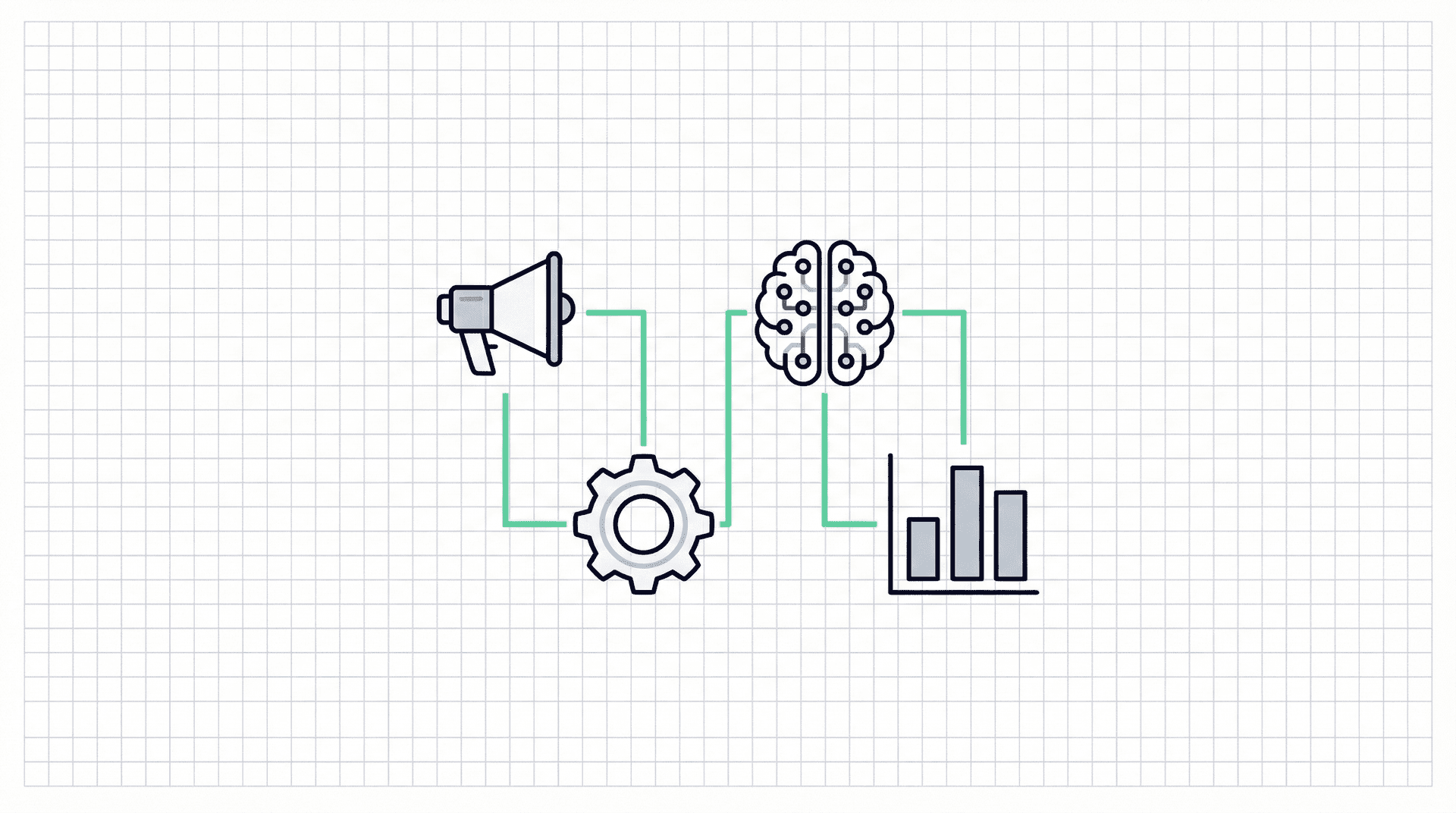
Most businesses are still running marketing on manual, fragmented campaigns: spreadsheets, disconnected tools, and reporting that arrives too late to act on. The result is missed opportunities, wasted spend, and a growing gap between what customers expect and what the business can actually deliver. The fix is a full AI marketing infrastructure: a connected system that handles data, content, execution, and measurement in one place.
The Imperative of AI Marketing Infrastructure in 2026
An AI marketing infrastructure is more than a collection of tools. It's a cohesive ecosystem where AI drives every facet of your marketing strategy, from data analysis and content creation to campaign execution and performance optimization. A few reasons it has become foundational rather than optional:
- Personalization at scale: Customers expect tailored experiences. AI analyzes large datasets to understand individual preferences and deliver relevant content, offers, and interactions across every touchpoint, which is impractical to do by hand.
- Predictive analytics: AI can forecast market trends, customer behavior, and campaign performance. That lets you move from reactive to proactive, anticipating needs and adjusting campaigns before they launch.
- Efficiency: Automating repetitive tasks, such as data entry, email scheduling, ad bidding, and basic customer service, frees marketers to focus on strategy, creativity, and harder problems. The operational savings follow.
- Customer journey optimization: AI can map the full customer journey, surface friction points, and suggest changes that lift conversion rates and satisfaction.
- Competitive edge: Teams that adopt AI tend to move faster, personalize more, and get more out of their spend than teams that don't.
Key Components of a Modern AI Marketing Infrastructure
Building an effective AI marketing infrastructure requires integrating several core components:
1. Data Integration and Management Platform
At the heart of any AI system is data. A solid infrastructure needs a centralized platform (such as a Customer Data Platform, or CDP) that aggregates data from every source: CRM, website analytics, social media, email marketing, sales, and third-party data. The platform cleans, organizes, and makes that data accessible for AI analysis.
2. AI-Powered Analytics and Insights Engine
This component uses machine learning to process the integrated data, surfacing patterns, trends, and actionable insights that manual analysis tends to miss. It gives you a clearer read on customer segments, campaign performance, and market dynamics.
3. Marketing Automation Tools with AI Capabilities
These tools automate routine marketing tasks, but with an AI layer on top. Think AI-driven email sequencing, automated social posting tuned for engagement, and lead scoring that prioritizes prospects by likelihood to convert.
4. Personalization and Recommendation Engines
Using AI, these engines deliver relevant content, product recommendations, and offers to individual customers in real time across channels. That is central to a better user experience and to driving conversions.
5. Predictive Modeling and Forecasting Tools
AI models can predict outcomes like customer churn risk, lifetime value, and the likely success of a given campaign. That helps you allocate resources more effectively and manage risk.
6. Content Generation and Optimization AI
From ad copy and email subject lines to blog topics and on-page SEO, AI tools can speed up content creation and improve how well it performs.
Steps to Building Your AI Marketing Infrastructure
This work goes best with a structured approach:
- Assess your current state: Evaluate your existing marketing tools, data sources, and team capabilities. Identify gaps and the places where AI can make the most immediate difference.
- Define your AI marketing strategy: Articulate your goals. Which specific marketing problems should AI solve, and how does that tie back to your business objectives?
- Select the right technology stack: Choose AI tools and platforms that fit your strategy, budget, and existing systems. Weigh scalability, integration, and vendor support.
- Phased implementation and integration: Start with pilot projects to test AI on a smaller scale. Then roll it out across marketing functions, keeping data flowing cleanly between systems.
- Train your team: AI is a tool, not a replacement for human expertise. Invest in helping your marketing team understand, use, and manage these tools well.
- Monitor, analyze, and optimize: Track how the infrastructure performs over time. Use the insights to refine strategy, tune models, and improve results.
The Grid Theory Angle: Custom Systems for Unrivaled AI Marketing Infrastructure
Off-the-shelf AI marketing products are a fine starting point, but they often miss the specific, complex needs of a growing business. That is where Grid Theory comes in. A genuinely useful AI marketing infrastructure isn't a one-size-fits-all product. It's a custom-built system shaped around your goals, your data, and your customer journey.
Our approach rests on four fundamentals:
- Clear goals: We start by understanding what you are trying to achieve, whether that's more leads, higher conversion rates, better retention, or something else, then align the infrastructure directly to those measurable goals.
- Your resources: We assess your existing data, technology, and team. Rather than forcing you into a rigid system, we build on your strengths and fold in new AI capabilities without wasting the investments you've already made.
- Iteration: Building this infrastructure is an ongoing process. We ship in iterative cycles so there's room for testing, feedback, and refinement, and so the system evolves with your business and your market.
- Working data: Data is the lifeblood of AI. We build solid data pipelines, keep data quality high, and apply analytics that pull real value out of what you have. Our systems are designed to make your data work harder.
Grid Theory doesn't just install tools. We build AI marketing systems tailored to your business, bridging the gap between generic products and your actual context so the infrastructure is not just functional but genuinely fit for purpose.
Conclusion
A full AI marketing infrastructure has shifted from nice-to-have to baseline for serious marketing teams. It brings personalization, predictive insight, real efficiency, and a clear edge. The work can look daunting, but a structured approach built around the right components and a clear strategy makes it manageable. With it in place, marketing moves from manual and reactive to automated, intelligent, and proactive.
Ready to Transform Your Marketing with AI?
Grid Theory designs and builds custom AI marketing infrastructures that drive real results. We'll work with you to understand your specific challenges and build a solution that fits your business. Book a discovery call with Grid Theory today to talk through how we can help you build an automated AI marketing infrastructure tailored to your needs.
Ready to Get Started?
Building the right systems doesn't have to be overwhelming. Grid Theory helps businesses design and implement solutions that actually work, no bloated platforms, no guesswork.
Book a discovery call and let's talk about what this could look like for your business.