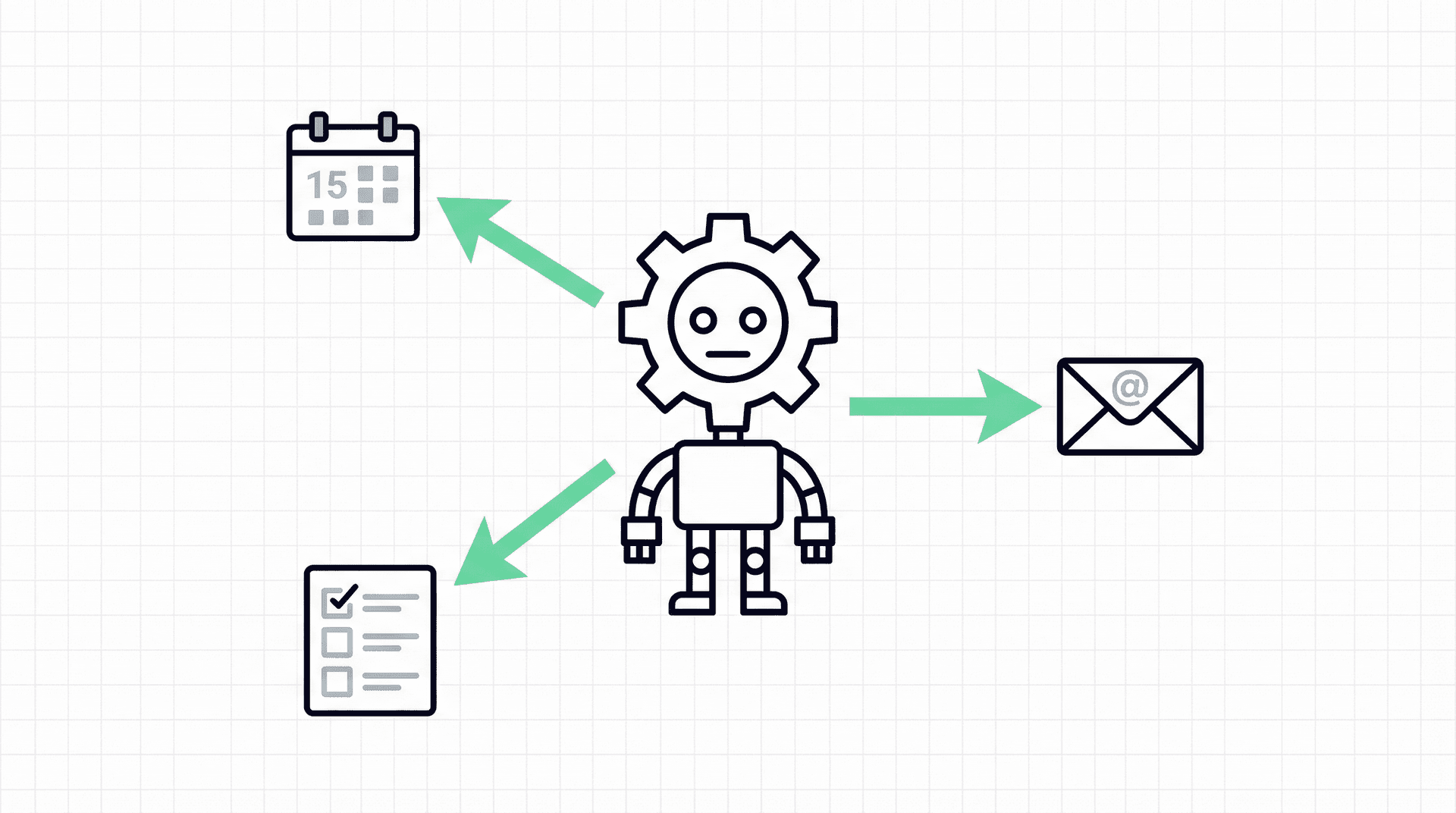
Business owners want systems that handle real work, not another dashboard to babysit. Artificial intelligence has promised this for years, but the shift worth paying attention to now is the AI agent. These software systems are not just tools; they are autonomous programs that can understand a goal, plan the steps, and carry out tasks with little human intervention. For businesses running intricate workflows that demand constant tuning, AI agents are becoming a practical way to get more done. This article explains what AI agents are, how they function, and how they can reshape your business workflows, with Grid Theory as the partner that builds them for you.
Understanding the Autonomous Power of AI Agents
At its core, an AI agent is a software system designed to perceive its environment, make decisions, and take actions to achieve specific objectives autonomously. Unlike traditional software that requires explicit instructions for every step, AI agents possess a degree of intelligence that allows them to reason, plan, and learn from their experiences. This autonomy is powered by advanced generative AI and large language models (LLMs), enabling them to process multimodal information, text, voice, video, code, and engage in complex problem-solving.
Key Characteristics of AI Agents
Several defining characteristics set AI agents apart from simpler AI applications like chatbots or basic automation scripts:
- Reasoning: AI agents can employ logic and available data to draw conclusions, identify patterns, and make informed decisions. This cognitive ability lets them work through complex scenarios and adapt when something unexpected comes up.
- Planning: They can develop strategic plans to achieve goals, breaking down complex tasks into manageable sub-tasks and evaluating potential actions to determine the most effective path.
- Acting: Based on their reasoning and planning, agents can execute tasks, interact with external systems, and perform digital or even physical actions.
- Observing: Through various forms of perception, such as natural language processing or data analysis, AI agents gather information about their environment to understand context and inform their decisions.
- Memory: Equipped with short-term and long-term memory, AI agents can maintain context, learn from past interactions, and personalize their responses and actions over time.
- Self-refinement: They possess the capacity to learn from feedback, adjust their behavior, and continuously improve their performance, making them increasingly effective over time.
AI Agents vs. AI Assistants vs. Bots
It's worth distinguishing AI agents from other AI-powered tools. While the terms are sometimes used interchangeably, their levels of autonomy and complexity differ significantly:
| Feature | AI Agent | AI Assistant | Bot |
|---|---|---|---|
| Purpose | Autonomously and proactively perform complex tasks | Assist users with tasks, requiring user input | Automate simple, predefined tasks or conversations |
| Capabilities | Complex, multi-step actions; learns, adapts, makes independent decisions | Responds to requests; provides info; recommends actions; user makes decisions | Follows rules; limited learning; basic interactions |
| Autonomy | High; operates and makes decisions independently | Moderate; requires user input and direction | Low; follows pre-programmed rules |
| Learning | Adapts and improves over time through machine learning | May have some learning capabilities | Limited or no learning |
How AI Agents Revolutionize Business Workflows
AI agents are poised to transform business operations by automating and optimizing workflows across various functions. Because they can handle complex, multi-step processes with little oversight, they open up real gains in efficiency, accuracy, and innovation.
Enhanced Efficiency and Productivity
By automating repetitive and time-consuming tasks, AI agents free up human employees to focus on more strategic, creative, and high-value activities. This leads to meaningful gains in productivity and operational efficiency. For instance, an AI agent can manage customer inquiries, process orders, or even conduct preliminary market research, allowing your team to concentrate on complex problem-solving and customer relationship building.
Improved Decision-Making
AI agents can analyze large amounts of data, identify trends, and surface actionable insights quickly. This data-driven approach leads to more informed and effective decision-making across all levels of an organization. Imagine an AI agent continuously monitoring market data, competitor activities, and internal performance metrics to provide real-time recommendations for strategic adjustments.
Streamlined Operations and Cost Reduction
From supply chain management to IT operations, AI agents can optimize processes, reduce errors, and identify bottlenecks, leading to substantial cost savings. They can manage inventory, predict maintenance needs for equipment, or automate software development pipelines, ensuring smoother and more cost-effective operations.
Personalized Customer Experiences
AI agents can deliver highly personalized customer interactions, from tailored product recommendations to proactive support. By understanding individual customer preferences and behaviors, they can improve satisfaction and loyalty, ultimately driving revenue growth.
Scalability and Adaptability
Businesses can scale their operations more effectively with AI agents, as these systems can handle increased workloads without the need for proportional increases in human resources. And because they learn and adapt, they can evolve with changing business needs and market conditions, staying relevant and effective over the long run.
The Grid Theory Angle: Crafting Bespoke AI Agent Systems
The potential of AI agents is real, but putting them to work takes a strategic, tailored approach. This is where Grid Theory excels. We understand that off-the-shelf solutions often fall short of addressing the unique complexities of each business. Our expertise lies in designing and building custom AI agent systems that are precisely aligned with your specific operational needs and strategic objectives.
At Grid Theory, we don't just implement AI; we engineer intelligent ecosystems. Our approach ensures that every AI agent solution we develop is:
- Goal-oriented: We begin by deeply understanding your business goals, ensuring that every AI agent is designed with a clear purpose and measurable outcomes. We don't just automate tasks; we automate towards your success.
- Resourceful: Our AI agents can draw on diverse tools, external data sources, and even collaborate with other agents to gather information and execute complex tasks efficiently. This mirrors the resourcefulness of a human expert, but at far greater scale.
- Intelligent: We integrate advanced reasoning and learning capabilities into our AI agents, allowing them to adapt to new information, refine their strategies, and continuously improve their performance over time.
- Dynamic: Our solutions are built to be flexible and scalable, capable of evolving alongside your business. Whether you need a single agent to automate a specific task or a multi-agent system to orchestrate complex enterprise-wide workflows, Grid Theory delivers dynamic solutions that grow with you.
We go beyond simply deploying AI; we craft bespoke systems that integrate seamlessly into your existing infrastructure, ensuring maximum impact and minimal disruption. Our focus is on creating AI agents that not only perform tasks but also understand the nuances of your business, anticipate needs, and proactively contribute to your success.
Ready to Get Started?
Building the right systems doesn't have to be overwhelming. Grid Theory helps businesses design and implement solutions that actually work, no bloated platforms, no guesswork.
Book a discovery call and let's talk about what this could look like for your business.