Engineering

Custom Software vs. Off-the-Shelf:

Grid Theory·
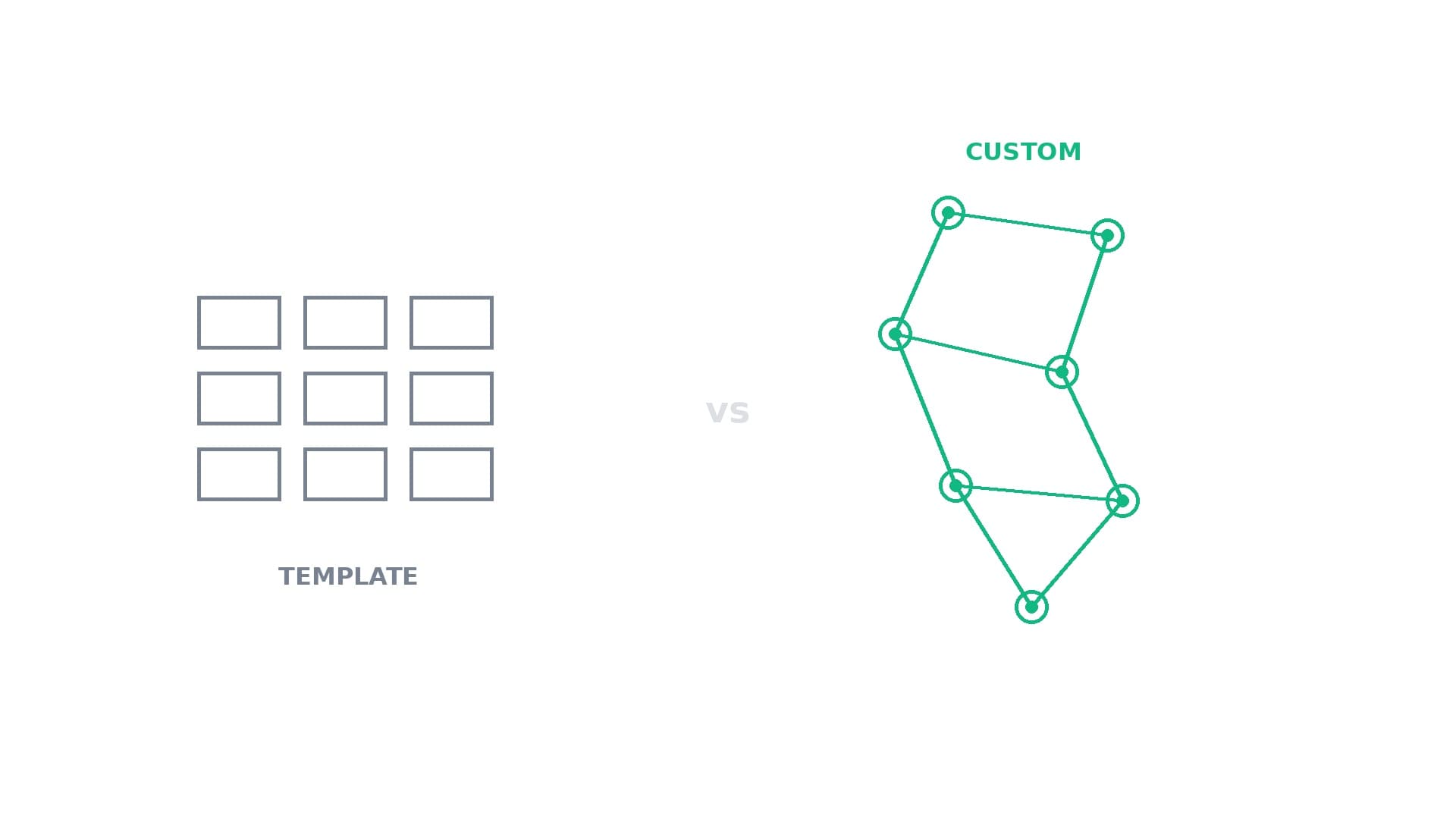
Custom Software vs. Off-the-Shelf:

Custom Software vs. Off-the-Shelf: How to Know When You've Outgrown Templates

Most businesses start with off-the-shelf solutions — and that's smart. But there's a tipping point where custom software becomes not just beneficial, but essential for growth. Here's how to recognize when you've hit that point.

Engineering 12 min read Updated January 2025

Every business faces the same question: should we customize an existing solution or build something from scratch? The conventional wisdom says "buy before you build" — and for good reason. Off-the-shelf solutions are faster to deploy, cheaper upfront, and come with established support systems.

But here's what the conventional wisdom doesn't tell you: there's a mathematical tipping point where custom software becomes the more cost-effective choice. Not just in the long term, but in terms of actual business growth and competitive advantage.

We've seen this pattern dozens of times. A client comes to us frustrated with their current tools — they're paying for features they don't need, missing features they do need, and spending hours on workarounds that should take minutes. They're not just hitting software limitations; they're hitting growth limitations.

The True Cost of Off-the-Shelf Solutions (It's Not What You Think)

Most businesses only calculate the obvious costs when comparing custom vs off-the-shelf software: subscription fees vs development costs. But that's like comparing the sticker price of a car without considering gas mileage, maintenance, or how well it actually gets you where you need to go.

The Hidden Costs of Template Solutions

  • Integration Tax: Every additional tool requires middleware, API connections, or manual data transfer. We've seen companies paying $2,000/month just in Zapier fees to connect systems that could communicate natively in a custom build.
  • Feature Bloat: You're paying for features your competitors use too, plus dozens you'll never touch. The average business uses less than 30% of their SaaS features.
  • Workflow Friction: When software doesn't match your process, your team adapts to the software instead of the software adapting to you. This compounds daily.
  • Data Silos: Customer information scattered across platforms means incomplete insights and missed opportunities.
  • Vendor Lock-in: The longer you use a platform, the harder it becomes to leave — even when it's clearly holding you back.

Real Example: $50K Annual Savings

One of our clients was paying $4,200/month across 6 different SaaS tools for their sales process, plus another $800/month in integration tools. We built them a unified custom CRM that handles everything for a $15K one-time build cost. They're saving $50K annually while actually improving their workflow.

The Custom Software vs. Off-the-Shelf Cost Analysis

Let's look at the real numbers. This interactive chart shows the total cost of ownership over 5 years for both approaches, including hidden costs that most businesses don't calculate upfront.

5-Year Total Cost of Ownership: Custom vs. Off-the-Shelf

*Based on average costs for a mid-size business ($1M-$10M revenue). Includes development, licensing, integrations, and opportunity costs.

When Off-the-Shelf Makes Sense (And When It Doesn't)

Off-the-Shelf Solutions Are Best When:

✓ Advantages:
  • Your process matches the software's workflow exactly
  • You need to be operational within days, not weeks
  • Your business model is standard for your industry
  • You have minimal integration requirements
  • You're validating a new business concept
✗ Limitations:
  • Limited customization options
  • Monthly recurring costs that scale with usage
  • Dependent on vendor roadmap and decisions
  • Competitive disadvantage (everyone uses the same tools)

Custom Software Is Best When:

✓ Advantages:
  • Your competitive advantage comes from your process
  • You're integrating 3+ different tools
  • You have unique compliance or security requirements
  • Standard solutions force inefficient workarounds
  • You want to own your data and infrastructure
✗ Limitations:
  • Higher upfront investment
  • Longer initial development timeline
  • Need to choose the right development partner
  • Ongoing maintenance responsibility

The 7 Signs You've Outgrown Off-the-Shelf Solutions

Here are the specific indicators we see when businesses are ready to make the jump to custom software:

1. The Integration Tax Is Higher Than Development Costs

You're spending more than $1,000/month connecting different tools. At that rate, you could fund a custom solution that eliminates the need for integrations entirely.

2. You're Paying for Seats You Don't Need

Most SaaS pricing scales with users, not value. If you're paying $100/month per user but only need basic functionality for half your team, custom software can be more economical.

3. Your Team Spends Hours on Workarounds

When we audit business processes, we typically find 2-5 hours per week per employee spent on tasks that could be automated or streamlined with purpose-built software.

4. You Can't Get the Reports You Actually Need

You have the data, but it's trapped across different platforms or in formats that don't match how you actually run your business. Custom software can surface the exact insights you need for decision-making.

5. Customer Experience Suffers from System Limitations

Your customers notice when you're juggling multiple platforms. Delayed responses, incomplete information, or clunky interfaces all stem from software that wasn't built for your specific customer journey.

6. You're Modifying Your Process to Fit the Software

This is the big red flag. Your process should drive your software choice, not the other way around. When you find yourself changing how you work to accommodate software limitations, it's time to consider custom development.

7. Your Competitive Advantage Requires Unique Capabilities

If what makes you different in the market can't be supported by standard software, you need custom software. Period.

The ROI Calculation That Changes Everything

Here's the formula we use: (Monthly SaaS costs + Integration costs + Productivity losses) × 24 months = Break-even point for custom development. If that number is higher than your custom build quote, the math is clear. Learn more about calculating automation ROI.

How Grid Theory Approaches Custom Software Development

We've built custom solutions for businesses ranging from automotive dealer onboarding platforms to marketing intelligence systems. Here's our philosophy:

No Templates, No Shortcuts

Every system we build is designed specifically for your workflow, your data, and your growth trajectory. We don't start with a template and customize it — we start with your business requirements and build exactly what you need.

AI-Native Architecture

We embed AI capabilities directly into the software architecture, not as an afterthought. This means intelligent automation, predictive insights, and adaptive workflows that get smarter as your business grows.

Full Ownership

You own your code, your data, and your infrastructure. No vendor lock-in, no recurring licensing fees, no restrictions on how you use or modify your software.

Speed Without Compromise

Our development process is optimized for speed: Discovery (3-5 days) → Blueprint (3-5 days) → Build (2-4 weeks) → Launch (3 days). Most clients are operational on their custom system within 6 weeks.

Key Takeaways: Making the Right Choice for Your Business

  • Start with off-the-shelf when validating new business models or when standard workflows fit perfectly
  • Switch to custom when integration costs exceed $1,000/month or when software limitations impact customer experience
  • Calculate total cost of ownership over 3-5 years, not just upfront costs
  • Consider competitive advantage: if your process is your differentiator, it needs purpose-built software
  • Factor in opportunity costs: time spent on workarounds is time not spent growing your business

The goal isn't to build custom software for the sake of it — it's to remove the software bottlenecks that prevent your business from scaling efficiently. Whether that means optimizing your existing tools or building something new depends on where you are in your growth trajectory.

Want to see how this applies to your specific situation? Read our guide on custom CRM vs. Salesforce or explore our automation services to understand what's possible with purpose-built software.

Ready to Outgrow Your Current Software Limitations?

Let's analyze your current software costs and see where custom development could accelerate your growth. In a 30-minute discovery call, we'll map out your process, identify bottlenecks, and show you exactly what a custom solution would look like for your business.

Book Your Discovery Call
G

Grid Theory

Building AI-powered infrastructure for businesses ready to scale.

We use cookies to analyze site traffic and improve your experience. By accepting, you consent to the use of cookies for analytics and advertising purposes.